On this page
- Separate the operating models before reviewing the price
- Build an activity-by-holder authority matrix
- Trace the route through the receiving facility
- A route comparison with disposal cost visible
- Inspect the delivered operating assets and downtime case
- Test customer history and open obligations
- Verify a complete operating chain
- Sources
Separate the operating models before reviewing the price
A business may install or repair private sewage systems, pump existing systems, provide scheduled service, rent portable units or perform several of these activities. Break revenue and direct cost into the actual service lines. Installation backlog, repeat pumping behavior and prepaid portable-unit rentals are different evidence of future work. A list of historic customers is not a contract or a promised pumping interval.
For each activity, identify the person doing the work, the operating entity, equipment, territory, customer or property type and any receiving or disposal facility. A combined financial statement can obscure which line uses the owner’s credential, which depends on a single truck and which carries an undelivered service obligation.
Build an activity-by-holder authority matrix
| Activity | Authority question | Evidence to collect |
|---|---|---|
| System installation or modification | Which individual holds the relevant installation authority, and what local approval applies? | IDPH verification, responsible person, actual work scope and local-health-agency response. |
| Pumping | Who holds the pumping contractor license for the work actually performed? | Individual status, post-close role and IDPH confirmation of the continuity plan. |
| Portable sanitation | Which business and technician licenses/certifications apply? | Business identity, technician/trainee roster, scope and responsible agency response. |
| Additional activities | Are other environmental, transport, employment or municipal requirements implicated? | Actual activities and jurisdictions, reviewed by the responsible authority and advisers. |
IDPH identifies distinct categories for installation and pumping contractors, portable-sanitation businesses and technicians. The code’s licensing provisions distinguish individual contractor licensing and separate examinations. An asset purchase, a plumbing credential or the continued use of a trade name does not establish every permission needed. Ask IDPH and the relevant local health agency what the proposed people, entity and work require after closing.
Record the license holder’s actual commitment, schedule and backup. A short seller transition is not an indefinite staffing plan. Link required compensation to the owner-function replacement review and verify any continuing authority before promising day-one service. This profile is not a system-design, entry, pumping or waste-disposal instruction.
Trace the route through the receiving facility
Ask where material from each service line is taken, what the receiving arrangement permits, which entity holds the account and what evidence supports continued access. Review contracts or written facility terms, account standing, hours, accepted material, documentation, fees, distance and a realistic alternative. A nearby point on a map does not show that a facility will receive the buyer’s loads.
Reconcile dispatch and customer records with load logs, facility receipts, supplier charges and billing for a stated sample period. Investigate gaps and keep environmental or compliance questions with the responsible specialists. Do not infer lawful handling from a disposal expense line or assume that the previous owner’s facility account automatically transfers.
A route comparison with disposal cost visible
| Hypothetical comparable crew-day | Case A | Case B |
|---|---|---|
| Completed jobs | 4 | 4 |
| Revenue per job | $400 | $400 |
| Revenue | $1,600 | $1,600 |
| Loaded crew labor | $500 | $600 |
| Vehicle/fuel cost | $180 | $260 |
| Receiving/disposal charges | $220 | $320 |
| Other direct cost | $100 | $100 |
| Contribution before common costs | $600 | $320 |
Case B produces $280 less daily contribution with the same job count and sales. These are illustrative amounts, not Illinois prices or facility quotes. Trace why the labor, miles and charges differ. A change in accepted loads, facility hours or travel can also make four jobs infeasible; the table does not prove the schedule fits. Include receiving waits and unloading in the crew-day worksheet as other paid time, and avoid adding that payroll twice.
Where receiving fees depend on volume or load type, reconcile the actual units and tariff. Truck tank size is not automatically usable legal payload, number of jobs per trip or permitted load. Vehicle specifications, condition, weight limits and operating requirements need separate qualified review. Do not derive capacity from a photograph or a seller’s nominal tank figure.
Inspect the delivered operating assets and downtime case
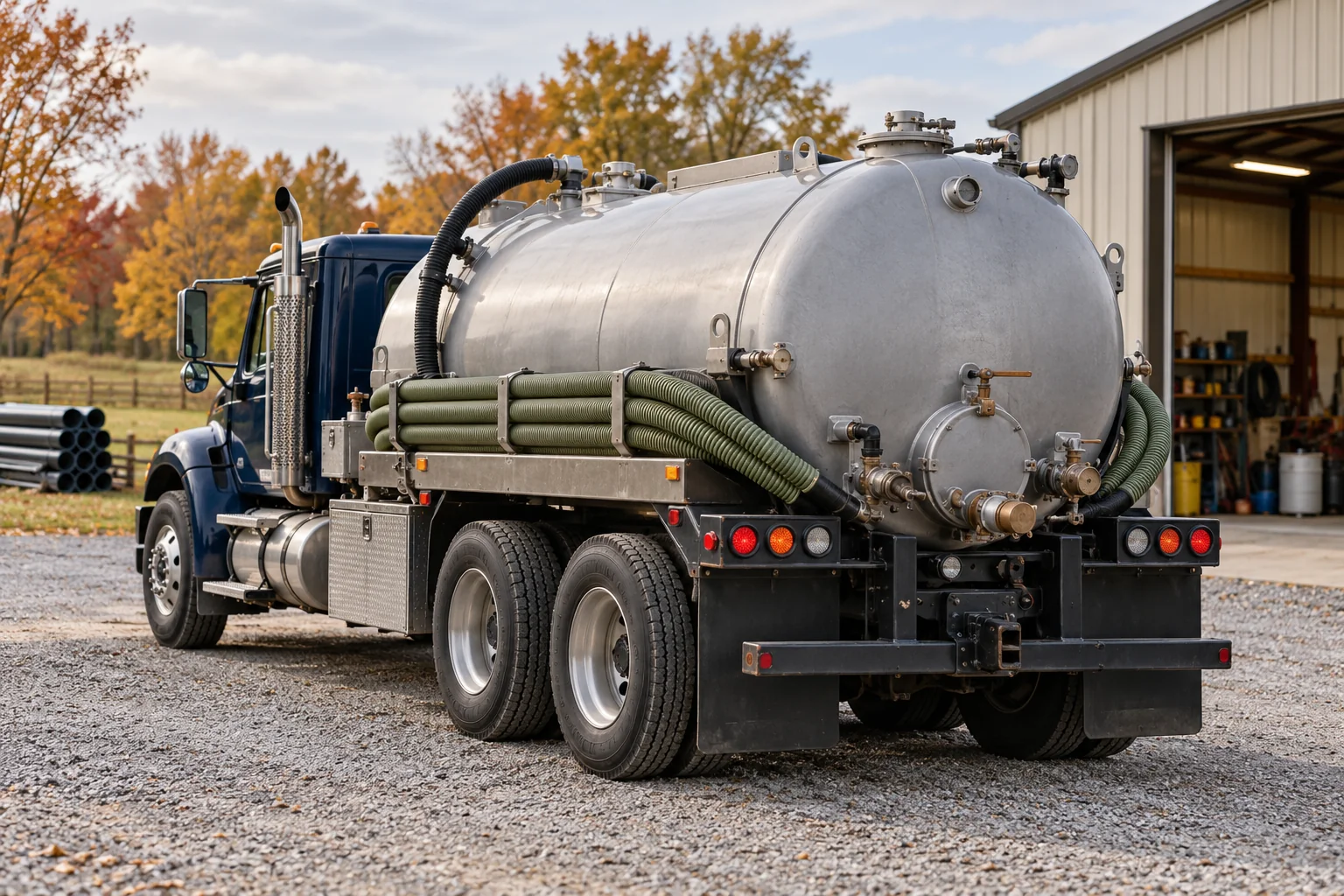
Create an asset-level register for vehicles, tanks, pumps, hoses, portable units and supporting equipment. Identify ownership, finance or liens, condition, maintenance, inspections and available parts. Use independent condition evidence appropriate to the asset and work. The fleet guide separates repairs already in earnings, catch-up needs, replacement capital and growth spending.
Stress-test a principal vehicle being unavailable during a busy week. Record the actual backup equipment, qualified operator, supplier lead time, rental feasibility and customer-service response. A proposed subcontractor must be available and appropriate for the work; entering a cost in a spreadsheet does not establish that backup. Separate lost capacity, repair cash and replacement funding rather than using one unsupported “maintenance reserve.”
Test customer history and open obligations
Review property-level service dates, actual invoices, cash, documented agreements and next scheduled work. Distinguish a customer’s prior repeat behavior from a signed obligation to buy again. For portable units or prepaid service, reconcile rental periods, pickup/removal duties, cleaning visits, deposits, refunds and future delivery cost. Connect those promises to the remaining-obligations schedule.
Segment household, commercial, municipal and other customer groups where their contract or collection patterns differ. Identify whether one referral relationship, receiving facility or large account controls a significant share of contribution. Use the concentration tool only with supported customer economics; facility dependence belongs in a separate operational dependency register.
Verify a complete operating chain
- Match activities, qualified people, entities and local territory to current authority.
- Confirm receiving arrangements and resolve the buyer’s account/access process in writing.
- Inspect the delivered equipment and fund the supported downtime and capital case.
- Reconcile a service sample from customer request through dispatch, facility record, invoice and cash.
- Assign future service, pickups, complaints, refunds and restricted records to an authorized owner.
- Keep unresolved agency, facility and equipment dependencies visible in the closing plan.
Companion resources
Use the printable or editable materials alongside the guide.
Septic operating-continuity registerIllustrative septic route economicsSources and scope
Source links support the specific topics noted. Examples and analytical frameworks are illustrative; confirm current requirements and transaction facts with the responsible advisers.
- IDPH — Private Sewage Disposal
Separates installation and pumping contractor licenses from portable-sanitation business licenses and technician certifications; identifies local health-agency involvement. Verify the actual holder, activity, territory and post-close process with IDPH/local authority. - Illinois — Private Sewage Disposal Code, 77 Ill. Adm. Code 905
Current code read in a browser. Sections 905.180 and 905.200 distinguish individual contractor examinations/licensing and portable-sanitation requirements. Used for diligence scope, not design, disposal instructions or proof of lawful day-one operations.
Continue your research
Browse the research library · Calculators and downloads · Trade profiles